
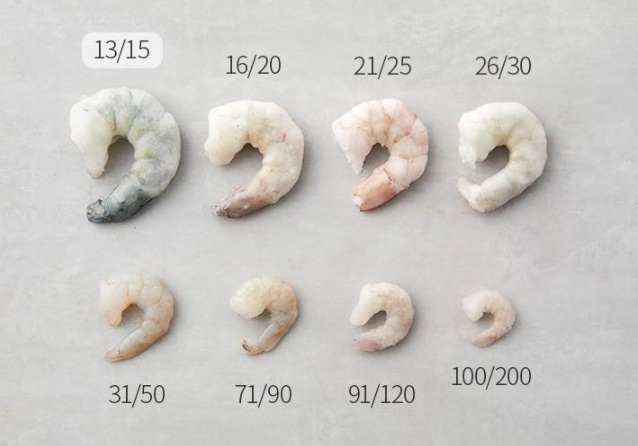
When buying frozen shrimp, one of the first details buyers check is the size grade. Product descriptions such as 21/25, 26/30, 31/40, and 41/50 are commonly used in the seafood trade, but what do these numbers actually mean?
Understanding shrimp sizes helps importers, distributors, restaurants, food processors, and local seafood businesses compare products and select the right shrimp for their needs.
In this article, we explain how shrimp size grades work, what the numbers indicate, and what buyers should confirm before placing an order.
What Do Shrimp Size Numbers Mean?
Shrimp size grades commonly indicate an approximate number of shrimp per pound for the specified product form. However, the counting basis can vary according to the product, processing form, and supplier’s specification.
For example, a grade of 21/25 generally indicates approximately 21 to 25 shrimp per pound under the applicable grading basis.
The basic principle is simple: a lower count number generally means larger shrimp, while a higher count number generally means smaller shrimp.
Buyers should always confirm whether the stated count applies to whole shrimp, headless shrimp, or another processed form.
Shrimp Size Chart: Common Commercial Grades
The following table provides a general reference to commonly encountered shrimp size grades.
| Size grade | General size indication |
|---|---|
| 4/6 | Very large shrimp |
| 6/8 | Very large shrimp |
| 8/12 | Large shrimp |
| 13/15 | Large shrimp |
| 16/20 | Medium-large to large shrimp |
| 21/25 | Medium-large shrimp |
| 26/30 | Medium shrimp |
| 31/40 | Medium to smaller shrimp |
| 41/50 | Smaller shrimp |
| 51/60 and above | Generally smaller shrimp |
These descriptions are indicative, not universal size classifications. Exact dimensions and count ranges depend on the applicable product specification and grading method.
Why Does Shrimp Size Matter?
Choosing the correct shrimp size affects more than appearance. It can influence portion control, preparation time, menu presentation, packaging, and purchasing calculations.
1. Restaurants and Food Service
Restaurants may select larger shrimp for grilled dishes, premium presentations, or individual servings. Smaller grades may suit rice dishes, noodles, soups, and recipes requiring multiple shrimp per portion.
The best choice depends on the recipe, serving size, and desired presentation.
2. Seafood Processing
Food processors may require particular size grades to maintain consistency across production batches. The processing form and size specification should be agreed upon before production or shipment.
3. Retail and Distribution
Retailers and distributors need clear product descriptions to compare suppliers and communicate specifications to their customers. Consistent labelling helps reduce misunderstandings when ordering repeat shipments.
Does Processing Form Affect Shrimp Size?
Yes. The product form is important when interpreting a size grade.
Common frozen shrimp processing forms include:
- HOSO — Head-On, Shell-On: shrimp with the head and shell intact.
- HLSO — Headless, Shell-On: shrimp without the head but with the shell.
- PD — Peeled, Deveined: peeled shrimp with the digestive tract removed.
- PND — Peeled, Not Deveined: peeled shrimp with the digestive tract remaining.
- PUD — Peeled, Undeveined: another commercial term used for peeled shrimp with the digestive tract remaining; confirm the supplier’s exact definition.
A size grade for one processing form should not automatically be treated as equivalent to the same grade for another form. The applicable count basis must be confirmed.
Vannamei vs Black Tiger: Are Their Size Grades the Same?
Vannamei shrimp (Litopenaeus vannamei) and Black Tiger shrimp (Penaeus monodon) are different species, each with its own characteristics.
Both may be offered in various commercial size grades, depending on product availability and processing requirements. However, the same stated count does not necessarily mean identical dimensions, weight distribution, or appearance across different species and product forms.
When comparing Vannamei and Black Tiger quotations, confirm the species, processing form, size grade, net weight, and packaging rather than relying on the size number alone.
What Should Buyers Confirm Before Ordering Frozen Shrimp?
Before requesting a quotation, prepare the following information:
- Shrimp species: Vannamei, Black Tiger, or another specified product.
- Processing form: HOSO, HLSO, PD, PND, or PUD.
- Required size grade and its counting basis.
- Frozen presentation and packaging format.
- Net weight per pack or carton.
- Destination market and applicable documentation requirements.
- Estimated order quantity and preferred delivery schedule.
Providing these details allows suppliers to evaluate the request more accurately and respond with a clearer product specification.
Looking for Frozen Shrimp from Indonesia?
Indonesia Shrimp presents frozen shrimp product options, including Vannamei Shrimp, Black Tiger Shrimp, Sea-Caught Shrimp, and Black Pink Shrimp, subject to confirmation of availability and specifications.
Buyers can review our product catalog to explore product categories and common processing options.
If you are an importer, distributor, wholesaler, restaurant group, or food processing business, contact us with your required species, size grade, processing form, packaging, destination market, and estimated quantity.
Contact Indonesia Shrimp
Website: https://indonesiashrimp.id
Email: marketing@indonesiashrimp.id
WhatsApp: +62 859-2732-2451
Contact our team to discuss your product requirements and request a quotation.
Size grades, counting methods, product availability, and specifications must be confirmed for each product and order.